
The Forger's Toolkit
How receipts and claim documents are faked today, what each technique leaves behind, and how to check for it without burying reviewers in false positives.
Five ways documents are faked, and what gives each one away.
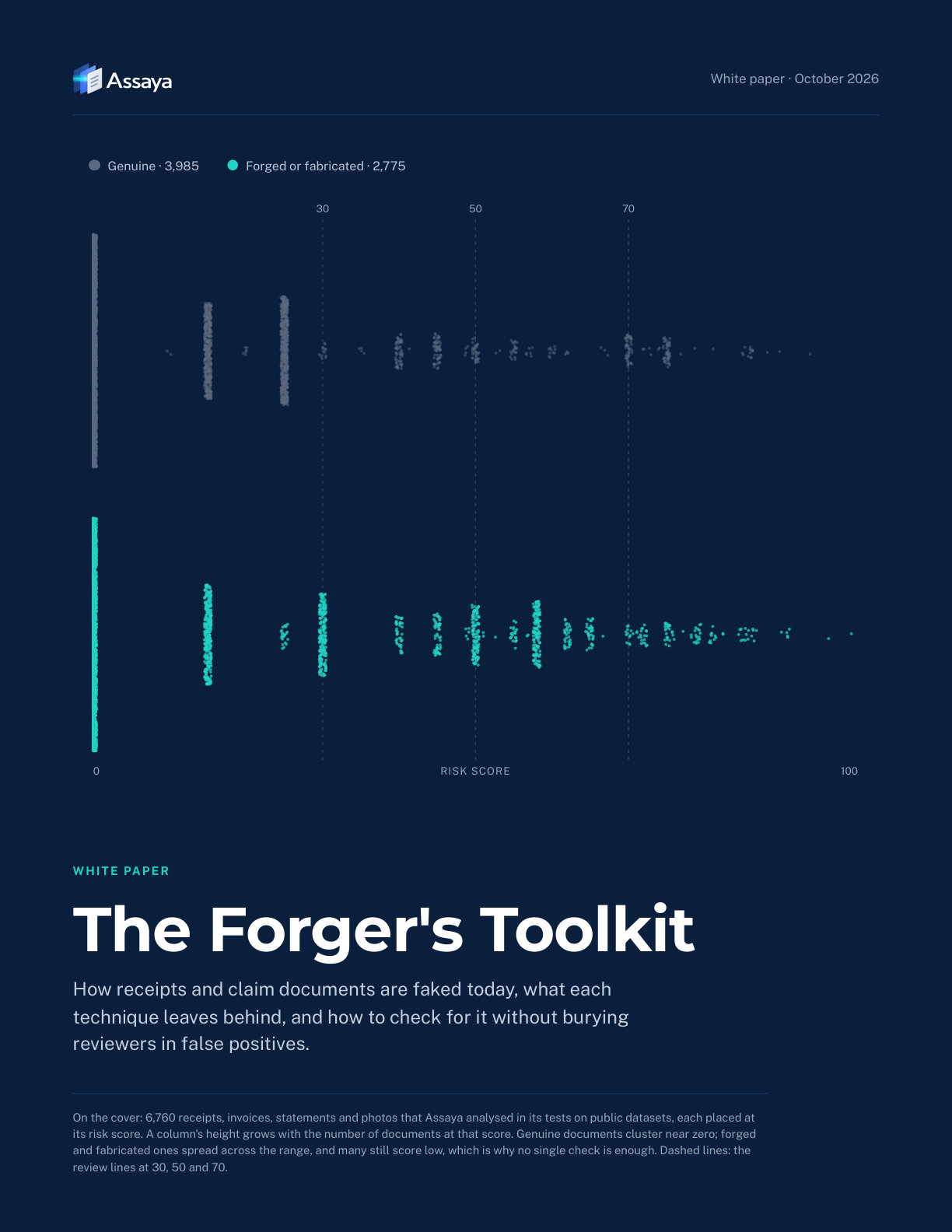
Editors, phone apps and AI image generators have made a convincing fake invoice or receipt a few minutes' work. This paper sorts what fraudsters actually do into five techniques, sets out the trace each one leaves in the file, the pixels or the numbers, and reports how well checks for those traces work on public test data, including where they don't.
- Six pages, with every industry figure sourced
- Measured on 6,760 documents from public test sets
- What to check first, for claims and expense teams
The five techniques at a glance.
1. Edit the real document
Opens a genuine PDF invoice or estimate in an editor and types a new total over the old one.
2. Edit the picture
Changes digits on a photographed receipt, or paints damage onto a photo.
3. Make it from scratch
Uses a receipt-generator website, a template, or an AI image generator.
4. Reuse a real one
Claims the same receipt twice, a colleague's, one from before the trip, or one larger than the card charge.
5. Fool the reviewer's AI
Hides instructions in the document for the language model that extracts or reviews it.
Also in the paper: separating fraud from ordinary paperwork, what we recommend, and how the measurements were made. Download the PDF
Proof before payout.
See how Assaya highlights suspicious findings, explains what triggered them and gives reviewers what they need to take the next step. A focused 30-minute walkthrough; no sensitive documents required.